Credit Card to Bank Account Transfer: Pay Tuition, Rent or Anyone for Under 1%
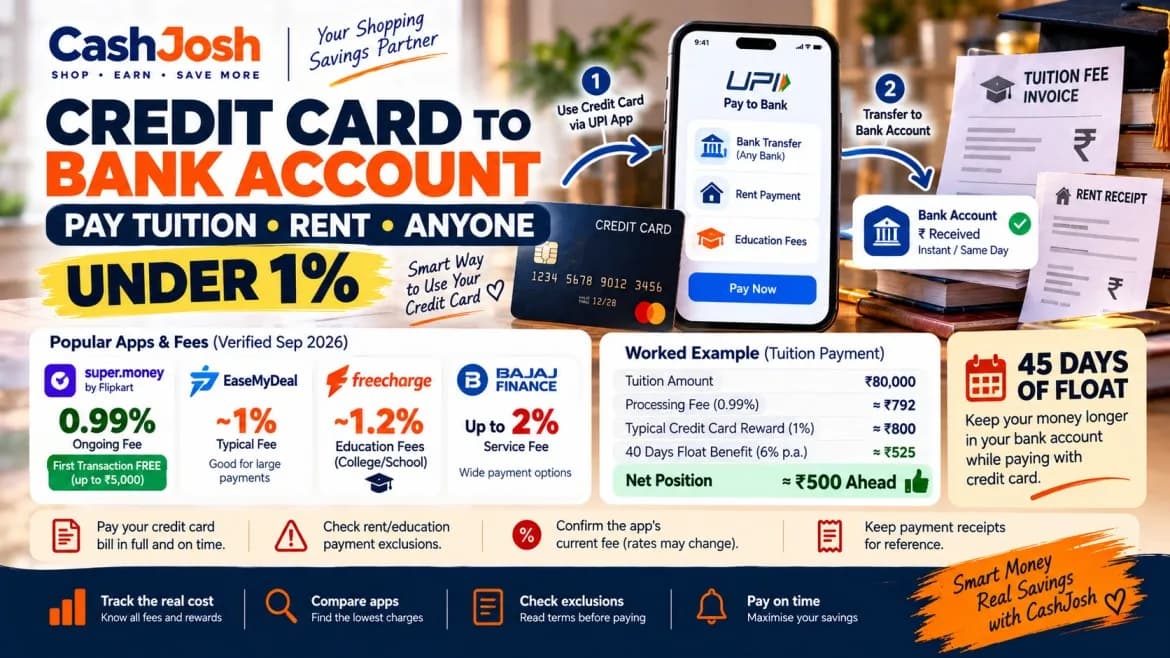
You can now send money from a credit card to almost any bank account for under 1%. What it actually costs, what the 45-day interest-free float is really worth in rupees, and a full worked example.
You can now send money from a credit card straight to a landlord, a college's fee account, or any registered vendor on UPI, using apps built around credit card linking, for a fee that's dropped to under 1% on the cheapest ones. That's new. Three years ago this meant wallets, cashback, and 2-3% fees that ate most of the point. Here's what actually changed, what it costs app by app, which bank's cards actually support it, and the real math on the thing people actually care about: the free 30-45 days before you have to pay it back.
What "credit card to bank account transfer" actually means
Normally a credit card only pays merchants who accept card payments. A landlord, a college, or your cousin's bank account can't swipe a card, so historically you either paid them separately in cash or bank transfer, and used the card for its own interest-free window on actual purchases.
UPI credit card linking changes that. A RuPay credit card links into a UPI app the same way your bank account does, and from there you can pay any UPI ID registered as a merchant, a college's fee collection account, a rent platform, a shop, a biller. The app in the middle charges a processing fee for making that conversion possible, since someone has to cover the card network's fee, and that fee is the entire cost of the whole trick.
You'll also see this called "CC to bank" transfer, same thing, shorthand people search for. Settlement on the recipient's side is typically instant or same-day, UPI is built for that, which is why a college's fee system usually marks the payment received within minutes, not days.
One real limit worth knowing before you plan around this: this only works for merchant-registered UPI accounts (what NPCI calls P2M), not a plain person-to-person transfer to a friend or relative's personal account. A college's fee portal and most rent-collection platforms qualify, since they register as merchants specifically to accept this. A random individual's UPI ID does not. There's also a per-transaction cap, typically ₹1 lakh on most issuers for merchant payments, some go higher depending on your bank and card. If your fee is close to or above that, check your card's specific limit before assuming one payment will cover it, you may need to split it.
This isn't just a personal-finance trick either. Small business owners use the same mechanism to pay suppliers or vendors registered on UPI, for the same reason: a short float on working capital without taking an actual loan. The fee and limit rules are identical, it's the same P2M rail either way.
What it costs, app by app
Based on current public information, always confirm the live rate in the app before paying since this moves:
- Super.money: free on your first transaction, then 0.99% ongoing, one of the lowest flat rates in this space right now. Check the current offer.
- CRED: supports sending to rent and education fee accounts specifically, fee varies by payment type.
- EaseMyDeal: around 1% flat.
- Freecharge: around 1.2% for education fee payments.
- Bajaj Finance: up to 2%, varies by transaction size and payment mode.
A 1 percentage point gap sounds small until it's on a real number. On a ₹1,00,000 tuition payment, 0.99% is ₹990. The same payment at 2% is ₹2,000. That gap alone is usually bigger than what your card earns back in rewards on the transaction, so which app you use matters more than which card you use.
Is there a way to do this completely free, zero charges, every time? Not as a standing rate, no, and be skeptical of anything that claims otherwise as a permanent deal rather than a limited promotion. What does exist right now: Super.money's first transaction at 0%, and apps occasionally run short promotional windows at 0% to acquire new users. Treat "free" as "free this one time, then the lowest ongoing rate you can find," which as of this check is Super.money's 0.99%, not as a permanent zero.
Which banks' credit cards actually work for this
The network matters more than the bank. This only works on RuPay credit cards, Visa and Mastercard credit cards cannot link to UPI in India at all, regardless of which bank issued them. A lot of people asking "does my SBI card work for this" actually have a Visa or Mastercard SBI card, which won't, while a RuPay SBI card will. Check the card network printed on your card, or in your bank's app, before anything else.
As of NPCI's current list, RuPay credit card UPI linking is live across 23+ banks, including these major issuers:
- SBI Card: live, RuPay variants only (not SBI's Visa or Mastercard cards).
- HDFC Bank: live, RuPay variants only.
- ICICI Bank: live, RuPay variants only.
- Axis Bank: live, RuPay variants only.
- Kotak Mahindra Bank: live, RuPay variants only.
- Also live: Punjab National Bank, Canara Bank, Union Bank of India, IndusInd Bank, Federal Bank, Yes Bank, RBL, IDFC FIRST, and several others.
If your card is RuPay and your bank is on this list, linking it takes a few minutes inside the UPI app itself (Google Pay, PhonePe, Paytm, or the app you're paying through), look for "Credit Card" under payment methods or linked accounts, and follow the OTP verification from your bank. The first 24 hours after linking usually carries a lower temporary spending cap as a fraud check, so don't link your card the same day a large fee is due, give it a day or two first.
The actual value: what 45 free days is worth
This is the part most people get wrong, they treat the interest-free period as a vague nice-to-have instead of putting a number on it.
Say you pay a ₹1,00,000 tuition bill on the day your card's billing cycle just started. Depending on the card, that can give you close to 45 days before the amount is due, up to the statement date plus the payment due date after that. You're not borrowing that money in any formal sense, there's no interest if you pay on time, but you do get 45 days where ₹1,00,000 that would otherwise have left your bank account today is still sitting there, available.
What's that actually worth? If you'd otherwise have pulled it from a savings account earning 3-3.5% a year, or a liquid fund earning closer to 6-7%, 45 days of float on ₹1,00,000 at even a conservative 6% annual rate works out to roughly ₹740 in what you'd have otherwise foregone, not a small side benefit, genuinely close to covering the entire 0.99% processing fee (₹990) on its own, before any card reward even enters the picture. Stack the float value and a 1% reward rate together and the "free" framing starts to actually hold up, not just as marketing language.
The flip side: if you don't actually have a plan for that ₹1,00,000, or you're carrying any other credit card balance at all, none of this math matters, you'll pay 40%+ annualised interest the moment you miss the due date, which wipes out any float benefit many times over. This only works for people who were going to pay the bill either way and are just choosing when.
A worked example, tuition
Fee due in 10 days, your card's statement just reset, giving you close to the full window:
- Processing fee at 0.99%: ₹792 on an ₹80,000 fee.
- Card reward at a typical 1% rate: roughly ₹800 back, category exclusions permitting.
- Float value on ₹80,000 for about 40 days at 6%: roughly ₹525.
- Net position: you come out close to ₹500 ahead, plus you still have the ₹80,000 available in your account for another month.
Drop the reward (some cards exclude education-category spends) and you're still roughly break-even purely on the float, which is the more honest way to think about this than assuming rewards alone justify it.
Does this work for rent too
Yes, the same apps generally route rent the same way they route tuition, a landlord's bank account isn't functionally different from a college's fee account to the payment rail underneath. If you're comparing apps for one, check whether it covers the other too, CRED explicitly supports both, and Super.money's linking works the same way regardless of what you're paying for.
Before you do this
- Check your card's actual exclusions. Some issuers exclude education or rent-category UPI spends from reward points even when the payment itself goes through fine. Read your card's terms, not the app's marketing page.
- Don't let a 0% first transaction tempt bad timing. A free first payment is real money, but not worth routing a payment a day later than you should just to catch a promo.
- Keep the app's payment receipt separately from the institution's own receipt, useful if there's ever a dispute about whether a fee landed on time.
- Never do this with a card you're already carrying a balance on. The float math only works if you were paying off your statement in full anyway.
Is Super.money legitimate
Worth answering directly since it comes up: yes. Super.money is owned and operated by Flipkart, launched in 2024, and by transaction volume it's become one of India's top-5 UPI apps, processing over 200 million transactions a month. The actual RuPay credit card behind it is issued through a licensed bank partner (Utkarsh Small Finance Bank), not Super.money itself, which is how card issuance works for every app in this space, none of them are banks. It isn't an anonymous app with no backing, it's a large, funded fintech product from a company most of India already uses for something else.
Separately from the transfer feature this guide covers, Super.money also runs its own UPI cashback program on everyday spends at partner merchants, that's a different feature with its own separate terms and redemption rules, not something this guide goes into.
The honest bottom line
The fee has come down enough, and the float is worth enough in real rupees, that paying tuition or rent with a credit card through one of these apps is a genuinely good move for anyone who already pays their card in full every month. It's not free money for everyone, run the numbers for your own card, your own fee amount, and your own billing cycle timing before assuming it's automatically worth it.
Try Super.money for the current first-transaction-free offer and an ongoing 0.99% rate, the lowest flat fee we found when we checked. That's a referral link, not a CashJosh-tracked cashback offer, we don't currently have a cashback partnership with Super.money.
Start earning cashback today
Join CashJosh free and get a welcome bonus in your wallet.
Browse Stores →Related Articles

Amazon Great Indian Festival & Flipkart Big Billion Days Quiz Answers 2026
Every Amazon Great Indian Festival and Flipkart Big Billion Days quiz answer confirmed so far for 2026, updated as new questions go live through the sale.

Cashback on Electronics in India: How It Actually Works
Electronics cashback rates are real but lower than fashion or beauty, here's why, what the actual rates look like, and how to stack it with a bank offer for real savings on phones, laptops and TVs.

Best Time to Buy Online in India: Month-by-Month Sale Calendar
A month-by-month guide to India's online sale calendar: Republic Day, Holi, EORS, the festive season, Pink Friday and year-end, and the real strategy for each window, not just which month.