Best Time to Buy Electronics Online in India: A Category-by-Category Guide
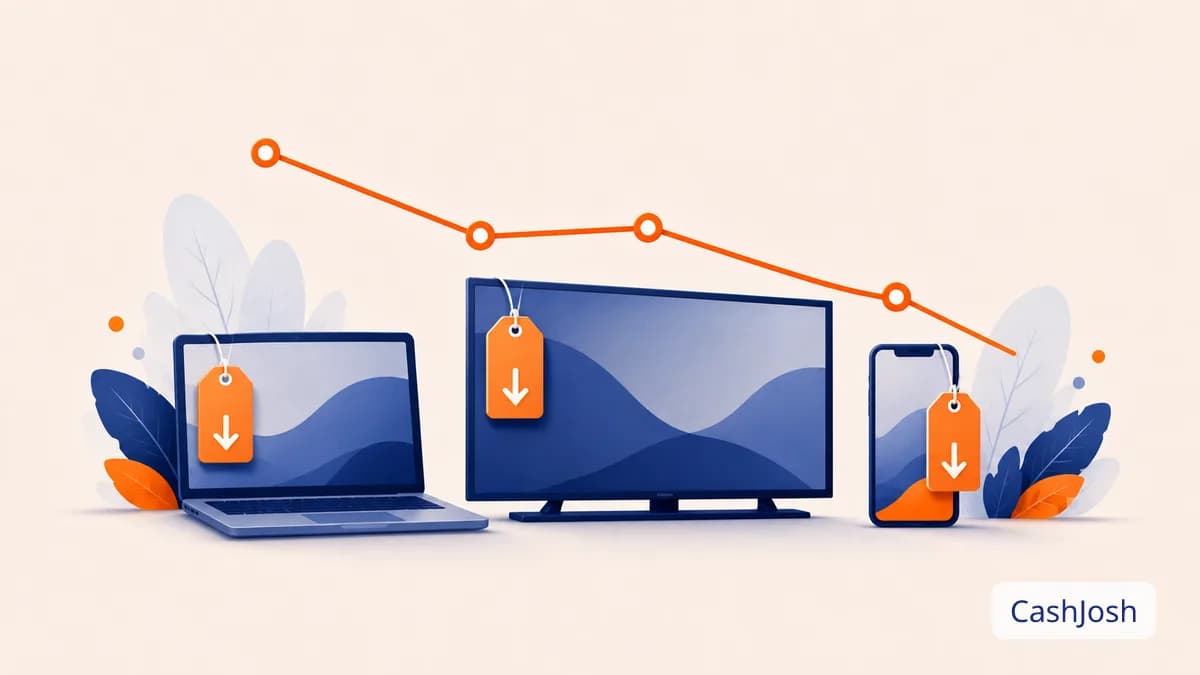
Laptops peak around back-to-school, TVs across the Dussehra-to-Diwali stretch, phones through the big autumn sales. The seasonal pattern behind India's deepest electronics discounts, plus how to time the sale calendar and the model-year cycle together.
Not every electronics category discounts at the same time of year, and the difference between good timing and bad timing on the same product is often larger than the difference between two competing brands. This is the real seasonal pattern in India, category by category, plus how to read the two forces that actually set the price on any given day.
The two things that move electronics prices
Almost every big drop is one or both of these:
- The sale calendar: india's online retail runs on a predictable rhythm of tent-pole events. Prices fall hardest in those windows because the platforms and brands fund extra discounting, and banks pile instant-discount offers on top.
- The model-year cycle: the moment a newer version is announced, the outgoing model becomes clearance stock. That markdown is frequently steeper than any festival discount, and it can land at an unglamorous time of year with no sale banner attached.
The best-case buy is when both line up: last year's flagship, already marked down for a refresh, discounted again during a tent-pole sale, with a bank offer stacked on top. That happens most often in the autumn festive window, which is why so much advice just says "buy during the big sales." But if you know the model-year cycle for your category, you can sometimes beat festive pricing in an off-season clearance.
The India sale calendar
Amazon and Flipkart run parallel events on roughly the same dates every year. Exact dates are usually confirmed only two to three weeks ahead, but the windows are stable:
| Window | Rough timing | Notes |
|---|---|---|
| Republic Day sales | Mid-January | First big electronics event of the year; solid on last year's models |
| Summer sales | Early-to-mid May | Smaller; decent on cooling appliances and mid-range phones |
| Prime Day / parallel sales | Early July | Strong on Amazon-exclusive and older-generation devices |
| Independence Day / Freedom sales | Early-to-mid August | Mid-size event, good bank offers |
| Great Indian Festival / Big Billion Days | Late September into October | The single biggest window of the year, opening two to three weeks before Diwali |
| Diwali run | Dussehra through Diwali (October into November) | The festive discounting continues and often extends past the headline sale |
| Year-end clearance | Late December | Quieter, but real clearance on anything the year-end brings a successor to |
In 2026, Diwali falls in early November, so the Great Indian Festival and Big Billion Days land in late September and October, and the festive stretch runs into the first half of November.
Laptops: July to September, and the chip-refresh clearance
Laptops have a seasonal discount window tied to the academic year, roughly July through September, when retailers run dedicated back-to-school promotions and stack bank-card instant discounts on top of regular pricing. The autumn festive sales are a strong second window.
The bigger lever, though, is the processor cycle. New laptop chip generations are typically announced at the start of the year and reach Indian retail over the following months. As soon as that happens, the previous-generation model, often nearly identical in real-world use, gets cleared out. If you don't need the newest silicon, buying the outgoing model right after a refresh announcement usually gets you the steepest markdown of the year, sale or no sale.
There is also a quieter clearance window in February and March, around the close of the financial year, when retailers push to move stock off their books. It rarely gets a marketing campaign, but price-tracking will show real dips on specific SKUs.
Practical tip: decide first whether you need this year's chip. If not, track the specific outgoing model you want and buy it in a clearance window rather than waiting for a festival, where the newest model will still barely move on price.
TVs: the Dussehra-to-Diwali stretch
TVs have the clearest seasonal pattern of any electronics category. The festive stretch from Dussehra through Diwali is consistently the year's best window, with discounts well beyond what is available the rest of the year. A strong secondary window opens in spring, when manufacturers launch new-generation panels and the prior year's models are marked down to clear inventory.
Practical tip: if a specific screen size or panel technology matters more than having the newest model, the spring clearance window on last year's flagship can rival festive pricing, and stock of larger sizes is usually better than it is late in the festive rush.
Smartphones: late September to December
The smartphone discount window is the widest of any category, running from the autumn tent-pole sales through Diwali and into the year-end sales. This is when the previous flagship generation, cleared out ahead of the next launch cycle, meets festive-season discounting and exchange bonuses at the same time.
Practical tip: a phone that launched six to twelve months before the autumn sales is usually the sweet spot of "still current" and "steeply discounted." Brand-new launches rarely move much on price in their first festive season. Check the exchange bonus separately from the headline discount; a large "up to" exchange figure often assumes a near-perfect recent phone, and the real offer for an average trade-in is much lower.
One more pattern: if a phone's successor has a known launch date in the next four to six weeks, wait. The current model almost always drops the week the new one lands, and India has no price-protection scheme to refund the difference if you bought early.
Audio and wearables: follow the phones
True wireless earbuds, headphones, and smartwatches don't have their own calendar; they discount alongside smartphones, because the same autumn sales and the same brands drive both. Budget and mid-range audio sees the deepest cuts in the festive window. One extra pattern: audio brands refresh their lineups often, so there is almost always a one-generation-old model selling at a large discount with no meaningful day-to-day difference for most listeners.
Bank offers and no-cost EMI: the discount on top of the discount
During every tent-pole sale, partner banks add an instant discount, usually advertised as "10% off." Two things to know:
- It is capped per card, often at a few hundred to a few thousand rupees depending on the bank, the category, and whether you pay outright or on EMI. On phones the cap is frequently low, so the effective discount on an expensive device is well under 10%.
- It stacks on the sale price, and cashback stacks on top of that, because each is funded by a different party.
No-cost EMI is a related but separate thing: the interest the bank would normally charge is shown as an upfront discount, and you repay the listed price in equal monthly instalments. It costs nothing extra in most cases, though some offers still carry GST on the notional interest or a small processing fee, so read the checkout breakdown.
You generally need the qualifying card before the sale opens. Banks cap the total value of an offer, and the most popular cards can run out of offer budget partway through a big sale, so applying the week before rarely helps.
Timing gotchas
- Warranty starts on the invoice date, not first use. Buying a few weeks early to catch a sale shortens the useful warranty window slightly. Usually fine, but it matters for expensive items.
- High-volume sale periods mean slower delivery and stricter returns. Popular configurations go out of stock within hours, restock at a higher price, and courier timelines stretch. If a launch or a warranty claim is time-sensitive, factor that in.
- The return window runs from delivery: if you buy on day one of a week-long sale and the item arrives late, your inspection-and-return period may end after the sale price is gone, so test the device promptly.
How to tell a real discount from a marked-up MRP
A "60% off" banner means nothing without a reference price. Before buying:
- Check the product's price history with a browser extension or a price-tracking site. You want the current price to be at or near its lowest in the last 60 to 90 days, not just below a rarely-charged MRP.
- Compare against the street price at a couple of other retailers on the same day. If everyone is within a few percent, the "sale" is mostly the normal price.
- Be wary of a discount that appears only after you add a specific bank card. That is a real saving, but it is the bank's money, not a deeper product discount, and it is capped.
A simple decision framework
- You need it this week: buy from whichever retailer has the best price today, apply any bank offer you qualify for, and route the order through a cashback link. Don't wait for a sale you can't time.
- You can wait a month or two. Note which window is next (see the calendar above), track the specific model, and set a price alert. Buy when the price hits its recent low inside that window.
- You're flexible on the exact model: target last year's flagship in a clearance window. This is usually the single best value in any category and doesn't depend on a festival at all.
Putting it together
| If you're buying... | Best window |
|---|---|
| A laptop | July to September back-to-school, or right after a chip-generation refresh |
| A TV | Dussehra to Diwali (October into November), or spring clearance on last year's model |
| A smartphone | Late September to December, favouring a phone that is six to twelve months old |
| Earbuds, headphones, a smartwatch | Alongside the autumn phone sales; consider the one-generation-old model |
None of this changes how CashJosh cashback works. The percentage is the same whether you buy during a sale or not, so a deep seasonal discount plus a bank offer plus your usual cashback rate is strictly better than buying full price off-season. For the full year-round sale calendar across every category, not just electronics, see our India Online Sale Calendar.
Ready to compare rates? Browse electronics stores sorted by highest cashback, or check today's active deals to see what is live right now.
Start earning cashback today
Join CashJosh free and get a welcome bonus in your wallet.
Browse Stores →Related Articles

India Online Sale Calendar 2026: Every Major Sale Window to Plan Around
Republic Day, Summer, Prime Day, Independence Day, Great Indian Festival, Big Billion Days, the Diwali run and the fashion End of Season sales. The full yearly pattern behind India's biggest shopping windows, and how to time a purchase around them.

Credit Card to Bank Account Transfer: Pay Tuition, Rent or Anyone for Under 1%
You can now send money from a credit card to almost any bank account for under 1%. What it actually costs, what the 45-day interest-free float is really worth in rupees, and a full worked example.

Amazon Great Indian Festival & Flipkart Big Billion Days Quiz Answers 2026
Every Amazon Great Indian Festival and Flipkart Big Billion Days quiz answer confirmed so far for 2026, updated as new questions go live through the sale.