India Online Sale Calendar 2026: Every Major Sale Window to Plan Around
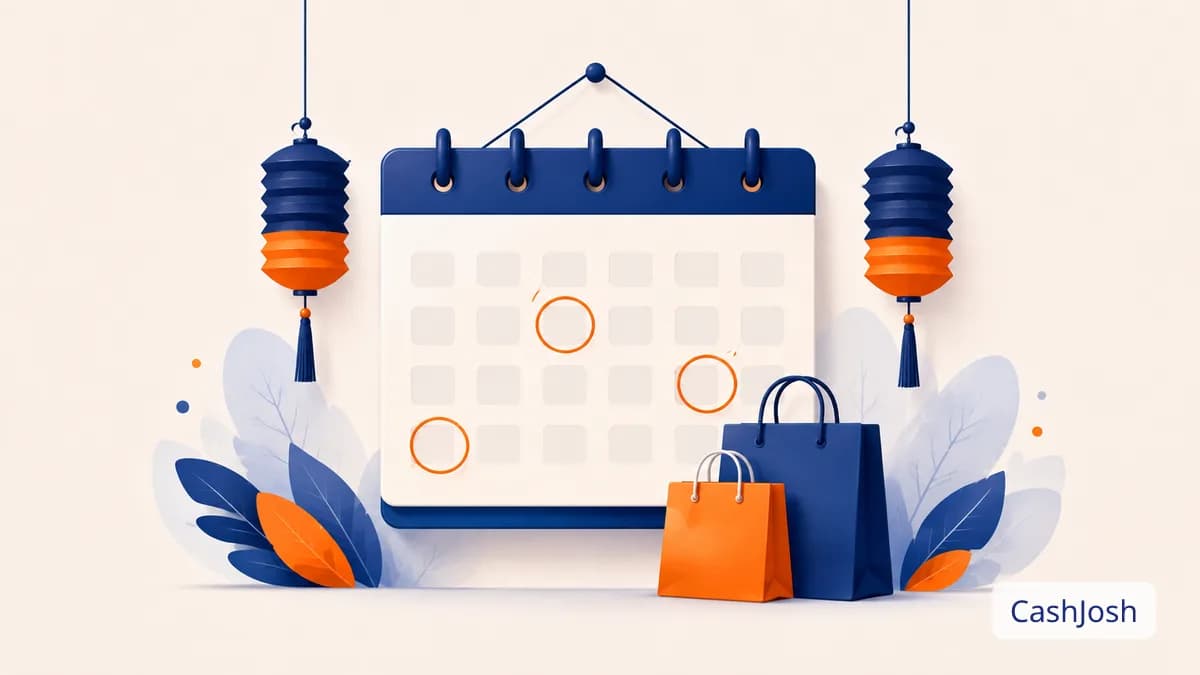
Republic Day, Summer, Prime Day, Independence Day, Great Indian Festival, Big Billion Days, the Diwali run and the fashion End of Season sales. The full yearly pattern behind India's biggest shopping windows, and how to time a purchase around them.
India's e-commerce calendar runs on a predictable yearly rhythm. A handful of tent-pole windows account for most of the year's deepest discounts, the two big platforms run parallel events on almost the same dates, and the pattern repeats closely enough year to year that you can plan a large purchase around it instead of guessing.
Exact dates are usually confirmed only two to three weeks ahead, and the festive dates move a little each year because Diwali follows the lunar calendar. In 2026 Diwali falls in early November, so the autumn sales land in late September and October. The windows below are what stays stable.
The year at a glance
| Window | Rough timing | Best for |
|---|---|---|
| Republic Day sales | Mid-to-late January | Electronics and appliances clearing last year's stock |
| Summer sales | Early-to-mid May | Cooling appliances, mid-range phones, travel gear |
| Prime Day and parallel sales | Early July | Platform-exclusive devices, older-generation electronics |
| Great Freedom / Independence Day sales | Early-to-mid August | Laptops and back-to-school electronics |
| Great Indian Festival / Big Billion Days | Late September into October | Flagship phones, premium electronics, everything |
| The Diwali run | Dussehra to Diwali (October into November) | TVs, large appliances, home upgrades, jewellery |
| Year-end clearance | Late December | Anything with a January successor |
| Fashion End of Season Sales | Late May to mid-June, and December to mid-January | Apparel and footwear, deepest markdowns of the cycle |
Republic Day sales: mid-to-late January
Amazon (Great Republic Day Sale) and Flipkart (Republic Day Sale) run the first big event of the year around Republic Day, typically starting in the second half of January and running roughly a week to ten days. Prime and Plus members usually get early access, often around 12 to 24 hours before everyone else.
Good for: electronics, appliances, and fashion clearing end-of-previous-year stock ahead of new launches. Not the year's deepest discounts, but a solid window if you don't want to wait until autumn.
Summer sales: early-to-mid May
Amazon's Great Summer Sale and Flipkart's parallel event run for roughly a week in early-to-mid May. This is a smaller window, but it is the best time of year for air conditioners, air coolers, refrigerators, and fans, since demand and competition peak right before the hottest months. Mid-range phones and travel gear also see reasonable cuts.
Prime Day and parallel sales: early July
Amazon's Prime Day is a members-only event, usually two to three days in early July, with Flipkart running a competing sale on the same dates. Discounts skew toward Amazon-exclusive brands, devices like Echo and Fire TV, and older-generation electronics being cleared before the autumn refresh. If you are not a Prime member, the Flipkart side of the week is open to everyone.
Great Freedom / Independence Day sales: early-to-mid August
Amazon's Great Freedom Festival and Flipkart's Independence Day Sale typically run from early August through the days around 15 August, with member early access starting up to 12 hours ahead. Bank offers in this window are usually strong.
Good for: laptops and back-to-school electronics. This window lines up with the start of the academic year, and retailers like Croma have run dedicated "Back to Campus" bank-card promotions around this exact period.
Great Indian Festival and Big Billion Days: late September into October
This is the year's biggest event by a wide margin. Flipkart's Big Billion Days and Amazon's Great Indian Festival open in the same late-September-to-early-October week, two to three weeks before Diwali. Flipkart's core event runs about a week; Amazon's festival is multi-phase and can stretch across several waves into the Diwali period, with different categories headlined on different days.
Good for: everything, but especially flagship smartphones and premium electronics, which see their steepest markdowns of the year here, stacked with bank-card offers and exchange bonuses. Prices on the first day are not always the lowest of the sale; some categories drop further in later waves, so check price history rather than assuming day one is best.
Popular configurations sell out within hours and often restock at a higher price, and courier timelines stretch during the peak. If a specific model and colour matters, be ready to buy the moment the sale opens rather than deciding mid-week.
The Diwali run: Dussehra to Diwali
The festive discounting does not stop when the headline sale ends. From Dussehra through Diwali, Flipkart's Big Bang Diwali Sale and the later phase of Amazon's Great Indian Festival keep running, often overlapping with the tail of Big Billion Days.
Good for: TVs, large appliances, furniture, and jewellery. Diwali is consistently the single best window for big home purchases, because gifting and home-upgrade demand peaks alongside retailer promotions. In 2026 this stretch runs through the first half of November.
Year-end clearance: late December
A quieter window with no single marketing banner. Retailers clear stock before the January financial and inventory reset, and anything getting a successor at the January launch shows real price dips. Check the price if you were already close to buying.
Fashion: End of Season Sales, twice a year
Fashion runs on its own cycle, roughly biannual: a mid-year window (late May through mid-June) and a year-end window (December through mid-January). Myntra's End of Reason Sale and Ajio's seasonal sales both follow this pattern, and apparel and footwear see deeper markdowns here than during the general festival sales, because the point is to clear a whole season's inventory.
Beyond Amazon and Flipkart
The tent-pole dates pull the rest of the market with them. During the same windows:
- Category specialists run parallel sales: Nykaa for beauty, Croma and Reliance Digital for electronics, Tata CLiQ and Ajio for fashion, Pharmeasy and Netmeds for wellness.
- Direct-to-consumer brands run their own festive sales on their own sites, and these are often where a specific product is cheapest, since the brand keeps the full margin and can discount harder than a marketplace reselling it.
- Travel has no fixed sale calendar. Flight and hotel prices are driven by how far ahead you book and by demand around long weekends and holidays, not by a festival date, though platforms do run occasional flash sales.
Always compare the marketplace price against the brand's own site and one specialist retailer before buying.
What tends not to discount much
Setting expectations saves a wasted wait:
- Brand-new launches: a phone, laptop, or TV released in the last few months barely moves on price in its first festival. The discount is usually a small bank offer and an exchange bonus, not a real price cut.
- Apple hardware. iPhones, iPads, and Macs see modest festive discounts at best, mostly delivered as a bank instant discount plus exchange value rather than a lower listed price.
- Staples and groceries: everyday consumables, household supplies, and most FMCG see only marginal sale-period movement. Buy them when you need them.
- Anything supply-constrained: if a model is hard to find at normal times, a sale rarely makes it both available and cheap.
How a big sale actually works
The final price you pay is usually built from four separate layers, each funded by a different party:
- The sale price: the platform's and brand's discount off the usual selling price.
- A bank instant discount: advertised as "10% off," but capped per card, often at a few hundred to a few thousand rupees depending on the bank and category. You typically need the qualifying card before the sale opens.
- A coupon, where one exists, applied at checkout on top.
- Cashback, calculated on whatever you actually pay after the three layers above.
Because they stack, the effective discount can be well above the headline number, or well below it if the bank cap is low on an expensive item. Two habits protect you: check the product's price history so you know the sale price is a real low and not a marked-up MRP, and open the store through a cashback link before you start shopping so layer four tracks.
Which sale for which purchase
| If you're buying... | Wait for |
|---|---|
| A phone or premium electronics | Great Indian Festival / Big Billion Days (late September into October) |
| A TV, large appliance, or furniture | The Diwali run (October into November) |
| A laptop | Independence Day sales (August), or the autumn festival |
| An AC or refrigerator | Summer sales (May) |
| Apparel and footwear | Fashion End of Season Sale (late May to June, or December to January) |
| Everyday items | Don't wait; buy when you need them and stack a cashback link |
For a category-by-category breakdown of exactly what to buy when across laptops, TVs, and phones, see our Best Time to Buy Electronics guide.
Using this calendar with CashJosh
None of this changes how cashback works. You still click "Shop & Earn" first, then shop as usual, and cashback is calculated on your final discounted price, so a deep sale discount plus your usual cashback rate beats buying at full price any other week. A few practical notes:
- Bookmark today's active deals rather than a fixed date. Exact start and end dates shift slightly year to year and are not always announced far ahead.
- Big-ticket purchases (laptops, TVs, appliances, jewellery) are worth waiting for one of these windows. Day-to-day purchases are not.
- Confirmation timelines don't change during sales: a Diwali TV purchase still takes the same category-typical confirmation window as any other time.
Ready to plan around the next one? Browse all stores or check current deals to see what is live right now.
Start earning cashback today
Join CashJosh free and get a welcome bonus in your wallet.
Browse Stores →Related Articles
Best Time to Buy Electronics Online in India: A Category-by-Category Guide
Laptops peak around back-to-school, TVs across the Dussehra-to-Diwali stretch, phones through the big autumn sales. The seasonal pattern behind India's deepest electronics discounts, plus how to time the sale calendar and the model-year cycle together.
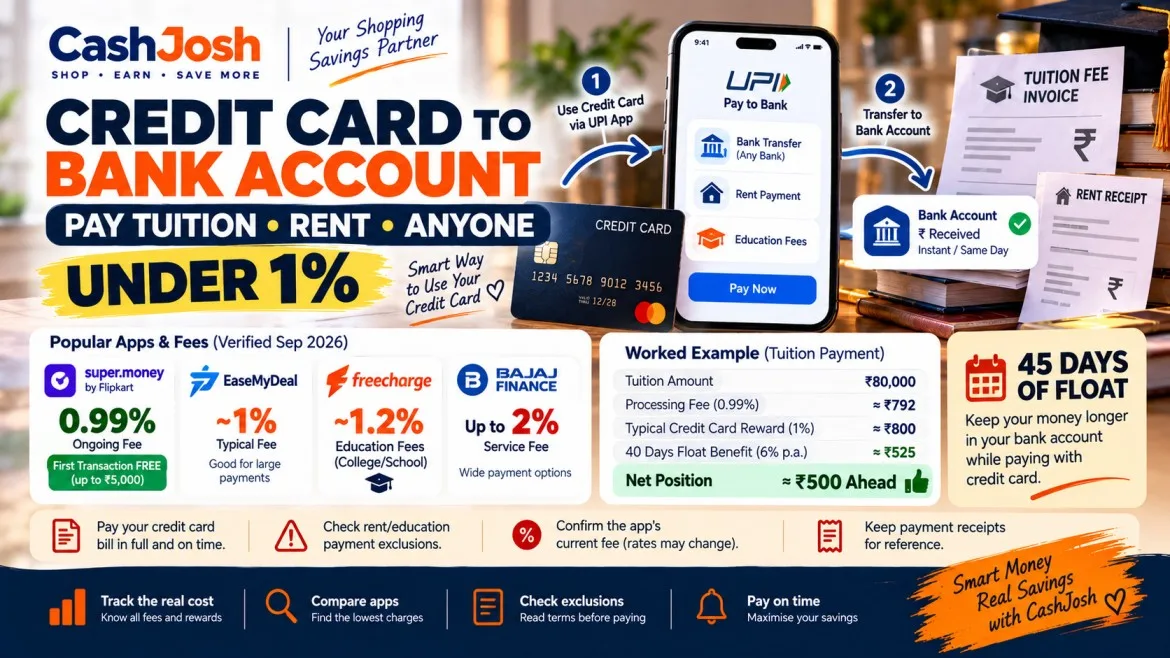
Credit Card to Bank Account Transfer: Pay Tuition, Rent or Anyone for Under 1%
You can now send money from a credit card to almost any bank account for under 1%. What it actually costs, what the 45-day interest-free float is really worth in rupees, and a full worked example.

Amazon Great Indian Festival & Flipkart Big Billion Days Quiz Answers 2026
Every Amazon Great Indian Festival and Flipkart Big Billion Days quiz answer confirmed so far for 2026, updated as new questions go live through the sale.